Art and Collectibles After Death: Appraisal, Insurance, and Sale
Inventory, appraise, insure, sell, or donate inherited art under 2026 IRS rules on qualified appraisals, Art Advisory Panel review, basis, and the 28% collectibles rate.
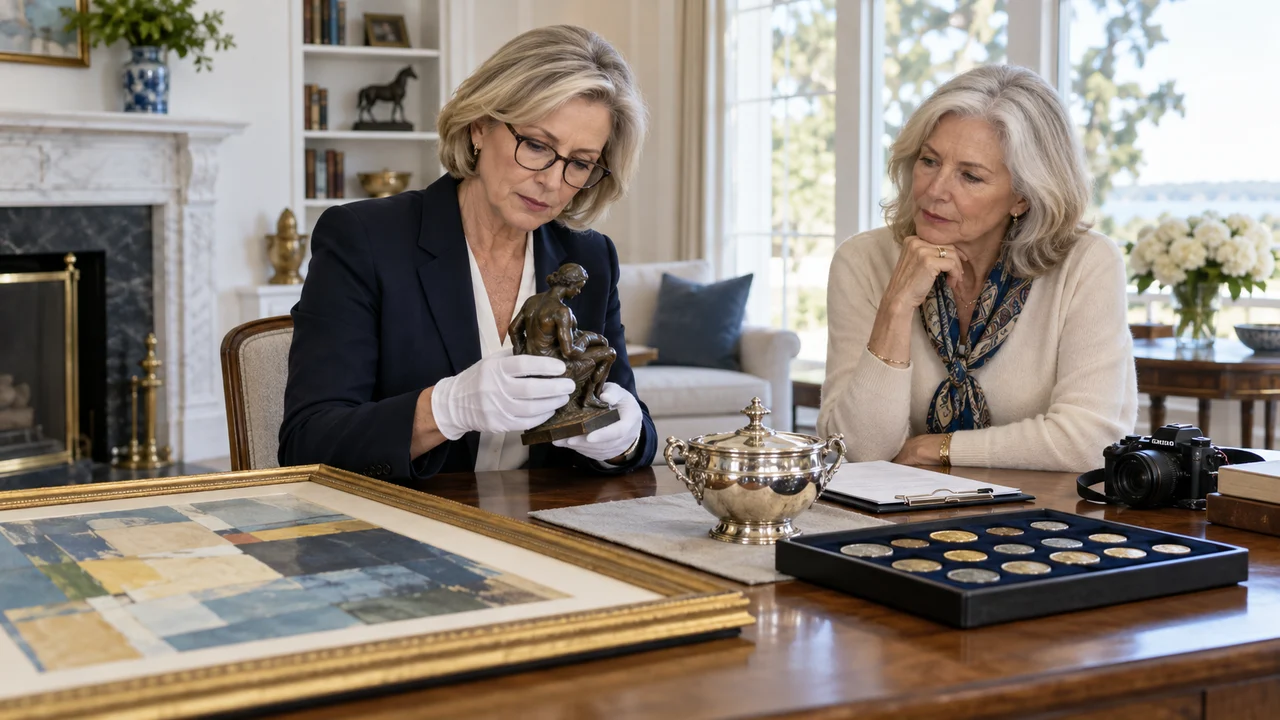
A collection changes its nature on the date of death. The painting in the hall, the silver in the pantry and the coins in the safe become, all at once, entries on an estate inventory, a tax basis you may carry for decades, and objects that someone must insure, sell, give away or keep. Much of what the collection will ultimately be worth to you is decided in the paperwork, long before any sale.
By the end of this guide you should be able to decide which pieces need formal appraisal, which to keep, and whether the rest belong at auction, in a private sale or in an institution.
Begin with an inventory and a provenance file
The Treasury regulation on valuing household effects, section 20.2031-6, calls a room-by-room itemization desirable, with each article named and valued, although articles in one room worth no more than $100 each may be grouped. Photograph each piece, front and back, with marks visible.
For anything of consequence, build a provenance file: invoices, earlier appraisals, certificates and conservation reports. IRS Publication 561 expects an art appraisal to address acquisition, prior ownership, exhibition history and authenticity, including whether the work appears in the artist’s catalogue raisonné. Condition and restoration affect value, so repair nothing before the appraiser has seen it. If family members will choose pieces, our guide to distributing personal possessions fairly explains how to sequence selection after valuation.
Commission appraisals that will survive review
When an estate tax return is filed, the July 2026 instructions for Form 706 require an expert appraisal under oath, with a statement of the appraiser’s qualifications, for any item or collection of similar items valued at more than $3,000. The standard is fair market value: what a willing buyer would pay a willing seller, neither compelled and both reasonably informed.
For charitable gifts, Publication 561 defines a qualified appraiser as someone with a recognized designation, or qualifying coursework and at least two years of experience, who regularly appraises for pay. It excludes the donor, the recipient, the dealer who sold the work, their employees and certain relatives, and it forbids fees based on a percentage of value. These are donation rules, but a good standard for any appraiser. Ask for a report prepared under the Uniform Standards of Professional Appraisal Practice, with analyzed comparable sales and professional photographs. The wider evidence file is covered in valuing assets at the date of death.
When the IRS Art Advisory Panel becomes involved
The IRS’s Art Appraisal Services staff review values claimed for art in income, estate and gift tax cases, advised by the Commissioner’s Art Advisory Panel of up to 25 art experts. The IRS says works sent to the panel generally have individual values above $150,000, though Art Appraisal Services has discretion. Panelists review without knowing the taxpayer’s identity, and Art Appraisal Services makes the final determination.
The referral trigger sits lower. Internal Revenue Manual section 4.25.12 directs examiners of an estate or gift return to refer any work claimed at $50,000 or more to Art Appraisal Services, except where the art passes to a surviving spouse or a qualified charity, or the return is nontaxable and unlikely to produce a deficiency. If one work dominates the estate, the executor can request a Statement of Value before filing for an item appraised at $50,000 or more; the 2026 fee is $8,400 for one to three items and $800 for each additional item. Art Appraisal Services may decline a request, so do not make the filing calendar depend on receiving one.
The spousal exception can create a false sense of ease. Art that passes to you may never be examined, yet its value still becomes your basis.
A value that costs the estate nothing today can still decide what you owe when you sell.
Your basis, and the 28% rate when you sell
Under Publication 551, your basis in inherited property is generally its fair market value at death, or on the alternate valuation date if the executor elects it. In community property states, both halves of the community interest generally take a new basis if at least half is included in the decedent’s gross estate. When an estate must file Form 706, certain beneficiaries must use the value reported to them on Schedule A of Form 8971. One exception matters for couples: appreciated property that you or your spouse gave the decedent within one year before death, a work you gave your husband in his final year included, keeps the decedent’s adjusted basis, not its date-of-death value, when it returns to you.
Where no federal estate tax is due, because the estate passes to a spouse or falls below the exemptions (the federal basic exclusion amount is $15,000,000 for 2026 deaths; a state that taxes estates sets its own threshold), an artificially low appraisal may provide no federal estate-tax benefit and can increase the taxable gain on a later sale. It can also distort state-tax filings, fiduciary accounting, insurance and division among beneficiaries. Our guide to basis and what changes on inheritance covers joint ownership and reporting.
The IRS places long-term collectibles gain, including gain on coins and art, in a special rate category capped at 28%. That does not mean every dollar is automatically taxed at 28%: the capital-gain tax calculation uses the taxpayer’s taxable income, other gains and losses, and applicable rate brackets. Publication 544 treats inherited property as held for more than one year regardless of how soon it is sold. Gain is the amount realized, after selling expenses, less your adjusted basis.
As a hypothetical, suppose a sculpture was appraised at $400,000 at death and later sells for a price that nets you $520,000 after commission and fees. At the 28% maximum, the $120,000 gain could cost up to $33,600 in federal income tax. That is before any state tax, and before the 3.8% net investment income tax, which can reach a single filer’s investment gains once modified adjusted gross income exceeds $200,000. If an early sale price departs sharply from the appraisal, show it to the appraiser and preparer before the estate return is filed.
Auction or private sale: read the consignment agreement
At auction, the seller’s commission and charges for photography, insurance and shipping typically come out of the hammer price. The buyer’s premium is added to the bidder’s cost, which shapes what bidders will pay. A reserve is a minimum price, usually kept confidential, below which the work will not sell; the Uniform Commercial Code’s auction provision, section 2-328, treats a sale as with reserve unless the goods are explicitly offered without one, and state law varies. A guarantee promises you a minimum whatever happens in the room; ask what the house, or any third party behind it, receives in return.
These terms are negotiated, so compare written proposals from more than one house. A private sale, through a dealer or an auction house, trades public price discovery for discretion and a known net figure. Before signing, confirm who has authority to sell: the executor, the trustee, or you.
Giving a work to a museum: the related-use rule
Publication 526 generally allows a fair-market-value deduction for capital gain property, but if the charity puts the work to a use unrelated to its exempt purpose, the deduction is reduced by the appreciation, which generally leaves your basis. The IRS example: a painting placed in a school’s library for study by art students is a related use; a painting the school sells is not. If the claimed value exceeds $5,000 and the charity sells the work in the year of the gift without certifying exempt use, the same reduction applies, and an uncertified sale in a later year, within three years of the gift, can require you to report part of the deduction as income.
Because inherited basis is generally the date-of-death value, the rule mainly reaches appreciation since death. Obtain the museum’s written plan for the work first.
A deduction above $5,000 generally requires a qualified appraisal and Form 8283, Section B; for art deductions of $20,000 or more, the appraisal is attached. The qualified appraisal must be signed and dated no earlier than 60 days before the contribution and no later than the due date, including extensions, of the return first claiming the deduction. If the report predates the gift, its valuation effective date must fall within that same 60-day window and no later than the contribution date; if the report is dated on or after the gift, the effective date must be the contribution date. For 2026, IRS Publication 505 says an itemizer deducts only the portion of charitable contributions above 0.5% of adjusted gross income, and a separate overall itemized-deduction limitation can apply at high taxable incomes.
Insure what you keep, in the right name
Tell the insurer about the death and confirm who is now the named insured. The Texas Department of Insurance, for one, warns that a standard home policy may cap what it pays for items such as coins and jewelry, or exclude some collectibles, and that extra coverage is available. Schedule significant pieces at appraised values, refresh those values periodically, and store appraisals and photographs away from the house. Confirm transit and exhibition coverage before any work leaves for a sale, a conservator or a museum loan. The broader review is in homeowners insurance after a death.
Ivory and other protected materials
The U.S. Fish and Wildlife Service says federal law permits keeping lawfully acquired ivory, or giving it away when nothing is received in exchange. Selling is different. Interstate sale of African elephant ivory is prohibited except for antiques under the Endangered Species Act and certain items with a de minimis amount of ivory. Pieces brought into the country under the exception for a household move or an inheritance may never be sold across state lines. An antique must be at least 100 years old, must not have been repaired or modified with a protected species after December 27, 1973, and, if imported, must generally have entered through a designated port. De minimis items must, among other conditions, contain less than 200 grams of ivory and predate July 6, 2016. The antique test also covers items made from other listed species, and some states go further. Have such pieces identified by species, and documented, before you consign them.
Questions to settle before anything leaves the house
- Confirm who owns each piece and who may sell, lend or give it.
- Complete a photographed inventory and provenance file.
- Engage an independent appraiser with the right specialty and a flat or hourly fee.
- Decide with the executor whether any work warrants a Statement of Value.
- Record each date-of-death value as your basis, with its appraisal.
- Model after-tax proceeds at the 28% collectibles rate, plus any net investment income tax, net of selling costs.
- Compare written consignment terms with a private-sale offer.
- Obtain a charity’s written statement of intended use before giving.
- Schedule retained pieces on insurance, including transit and loans.
- Check federal and state rules before selling anything containing ivory.
This article provides general U.S. educational information and is not legal, tax, appraisal, insurance, or investment advice. Confirm current rules with the IRS, the U.S. Fish and Wildlife Service, your state, and qualified professionals who know your facts.
Primary sources
- Internal Revenue Service: Instructions for Form 706 (07/2026)
- Internal Revenue Service: Art Appraisal Services
- Internal Revenue Service: Publication 561 (12/2025), Determining the Value of Donated Property
- Internal Revenue Service: Publication 526 (2025), Charitable Contributions
- Internal Revenue Service: Topic No. 409, Capital Gains and Losses
- Internal Revenue Service: Publication 551 (12/2025), Basis of Assets
- Internal Revenue Service: Publication 544 (2025), Sales and Other Dispositions of Assets
- Internal Revenue Service: Topic No. 559, Net Investment Income Tax
- Internal Revenue Service: Publication 505 (2026), Tax Withholding and Estimated Tax
- U.S. Fish and Wildlife Service: Elephant Ivory FAQs
- Texas Department of Insurance: Collectibles: Why You May Need Extra Coverage
This article provides general education, not individualized legal, tax, investment, insurance, or benefits advice. Rules and deadlines change; verify the current requirement with the agency and a qualified professional.
More from Private Wealth
The desk →
Private Wealth
Before Buying a Private Fund: A Due-Diligence File
Review a private fund before subscribing: strategy, manager, fees, conflicts, liquidity, capital calls, valuation, tax reporting, side letters, and estate transfer.
Private Wealth
Charitable Lead Trusts: Charity First, Family Later
Learn how charitable lead annuity and unitrust arrangements divide payments between charity and family, and examine gift, income-tax, investment, filing, and governance tradeoffs.

Private Wealth
Family Limited Partnerships: Control, Value, and Risk
Understand what a family limited partnership can organize, why real operation matters, and how to document funding, gifts, valuation, tax reporting, and succession.