Gardening After Loss: Design a Safer, Easier Garden
Keep a beloved garden manageable after loss with USDA zone guidance, native planting, safer paths, heat precautions and the right way to hire garden help.
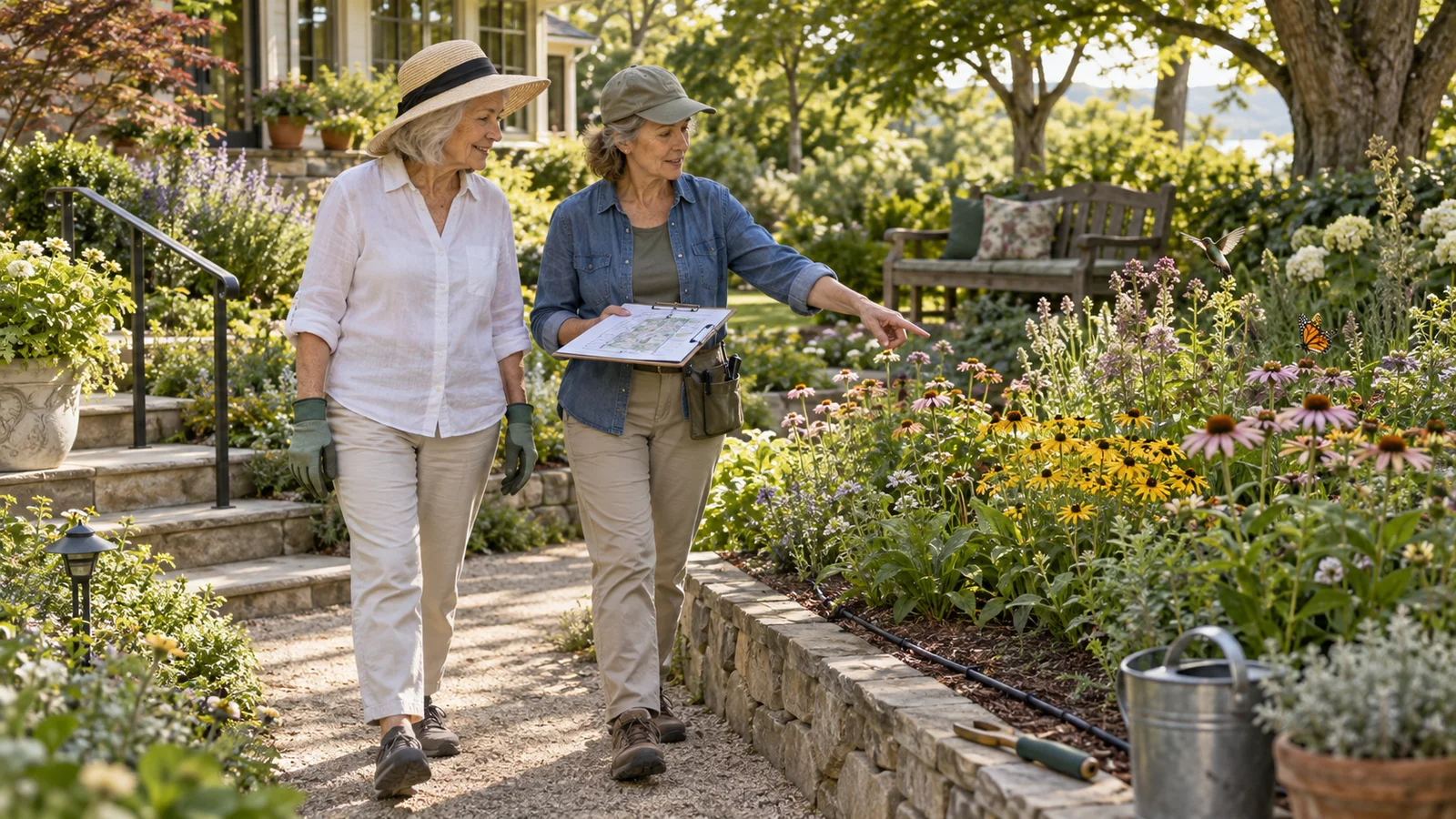
A garden keeps a calendar that owes nothing to probate deadlines or tax dates: the first bulbs, the June roses, the autumn clearing, the winter weeks when the catalogs arrive. It asks for attention each morning and gives something back the same day.
It may also have been your spouse’s domain, or a shared project now missing half its labor. The answer need not be giving it up. Decide which parts to keep in your own hands, how to reshape the ground, where to find free expert advice, and how to hire help without creating an avoidable tax or liability problem. A one-page garden brief can turn those decisions into instructions that survive from one crew visit to the next.
The garden as a daily structure
Routine is an underrated comfort. Plants need water on their schedule, not yours, and a morning walk to see what has changed is a reason to be outside, attending to something other than paperwork. Keep the work you genuinely enjoy, whether cutting flowers for the house or planning a border, and delegate the rest.
Put a few garden occasions in the diary: a planting weekend with a grandchild, a nursery visit with a friend, the autumn bulb order. Our guide to putting something in the calendar worth getting to explains why small plans made with other people tend to hold.
Know your ground: the 2023 hardiness zone and its limits
The 2023 USDA Plant Hardiness Zone Map, produced by the Agricultural Research Service, is the standard for judging which perennials are most likely to thrive where you live. It is built on the average annual extreme minimum winter temperature for 1991 to 2020, in 10-degree Fahrenheit zones from 1, the coldest, to 13, the warmest, each split into 5-degree “a” and “b” halves. Enter your ZIP code on the USDA site to find yours.
The USDA attaches three cautions. The zones average the coldest nights; they do not predict the coldest night to come, so a plant at the edge of its range can be lost in one hard snap. The map, drawn at a half-mile scale, cannot see microclimates such as a sheltered bed against a south-facing wall or a frost pocket. And if your zone changed from the 2012 edition, that is no reason to remove plants; what has thrived will most likely continue to.
Hardiness measures cold alone. Wind, soil, moisture, humidity, and summer heat decide much of the rest, which is why the USDA points gardeners to Master Gardeners and extension services. A second home needs its own lookup.
Free expert advice: Cooperative Extension and Master Gardeners
The most knowledgeable garden adviser in your county may charge nothing. Cooperative Extension carries land-grant university research to local communities. The USDA’s National Institute of Food and Agriculture, the federal partner in that system, keeps a directory of each state’s land-grant institutions and extension services; start there to find your county’s office.
Many extension services run Master Gardener programs, in which trained volunteers answer residents’ questions. Penn State Extension’s garden hotline is a representative example: Master Gardeners in 58 Pennsylvania counties take questions on soil testing, plant selection, pruning, plant diseases, insects, and lawn care. They favor integrated pest management and, when a problem cannot be diagnosed locally, may consult the university’s Plant Pathology Clinic or Entomology Lab. A photograph or sample speeds diagnosis.
Use this advice for a second opinion on anything a landscape company proposes to remove, spray, or replace, and for a soil test before significant replanting. If you would enjoy the reverse role, the same programs train volunteers.
Native plants and a garden that asks less of you
The U.S. Forest Service makes a practical case for native plants. They are adapted to local climate and soil, and they supply nectar, pollen, and seed for native butterflies, insects, and birds. Its guidance notes that well-matched native plantings can need less supplemental water, fertilizer and pesticide than conventional lawn, while a native prairie does not need routine mowing.
For a household that relies on paid help, that list doubles as a maintenance budget. Native is not effortless: a new planting needs watering and weeding while it establishes, and not every native suits every site. Ask your local native plant society, as the Forest Service suggests, or your extension office for species that fit your region.
Reshaping the garden for the decades ahead
The reasoning in adapting the house before you need it adapted applies outdoors too, where uneven ground, wet stone, and poor light are everyday hazards.
Design the garden you will want at eighty-five, and plant it while you are still the one choosing.
- Raise the work. Raised beds and tall planters bring the soil to you and reduce kneeling. Keep them narrow enough to reach the center without leaning in.
- Make daily routes firm and level. Replace loose gravel and uneven stepping stones with a stable, slip-resistant surface, and add a handrail wherever a path changes level.
- Light the routes you actually walk. Low path lighting from the back door to the potting area and gate, on a timer or sensor, matters more than uplighting in the trees.
- Bring the water closer. Drip irrigation on a timer and an extra spigot near distant beds remove the heaviest recurring chore.
- Choose tools for the hands you will have later. Lightweight, long-handled tools with thick grips, a kneeler with handles, a four-wheeled cart.
An occupational therapist can help match tasks and tools to your strength, reach and balance; a landscape architect can integrate those needs into the paths, grades, beds and lighting so the result feels intentional rather than clinical.
Working outdoors in summer heat
Heat is easy to underestimate in a garden. The CDC notes that older adults do not adjust as well as younger people to sudden temperature changes, are more likely to have a chronic condition that changes the body’s response to heat, and are more likely to take prescription medicines that affect temperature control or sweating.
The CDC’s advice: drink more water than usual and do not wait for thirst; if your doctor limits your fluids or prescribes water pills, ask how much to drink in hot weather. Wear loose, lightweight, light-colored clothing. Avoid very strenuous activity, and do not rely on a fan as your main cooling source when it is really hot. The CDC HeatRisk Dashboard gives a local forecast and recommended actions by ZIP code. Our own advice: leave hauling and digging to the crew, and garden early.
The CDC also advises checking on a friend or neighbor and having someone do the same for you. If you garden alone, keep a phone in your pocket. Seek medical care immediately for signs of heat-related illness such as muscle cramps, headache, nausea, or vomiting.
Hiring garden help, and supervising it well
Whether a gardener is your employee or an independent business has legal consequences. IRS Publication 926 for 2026 lists yard workers among its examples of household workers. A worker is your household employee if you can control not only what work is done but how it is done; part-time hours or payment by the job do not change that. By contrast, in the IRS example of a lawn-care business that serves the public, hires its own helpers, and supplies its own tools, neither owner nor helpers are your employees.
If a gardener is your employee, federal obligations begin at modest amounts. For 2026, Social Security and Medicare taxes apply once you pay one household employee $3,000 or more in cash wages, and cash wages include checks and money orders. Publication 926 says not to count wages paid to your spouse, a child under 21, a parent except in a stated childcare exception, or an employee under 18 whose principal occupation is not household employment. Federal unemployment tax applies if you pay household employees $1,000 or more in any calendar quarter of 2025 or 2026. Federal income tax is different: you are not required to withhold it from household wages, and should do so only if the employee asks and you agree. The employer generally reports these taxes on Schedule H and gives a covered employee Form W-2; verify the filing dates and whether Form I-9 is required for the particular hire. State unemployment, wage, paid-leave and workers’ compensation rules can add obligations. Involve your accountant or a household payroll service before the first payment.
With a company, ask about licensing where your state requires it, liability insurance, workers’ compensation coverage, and who is responsible for injuries to its crew. If anyone will apply pesticides, ask for the applicator’s credential and verify it with the state lead agency. The EPA’s certification overview explains that federal certification rules govern restricted-use pesticides while states may impose broader requirements. See our guides to hiring contractors safely and insuring a high-value household.
Supervision is mostly a matter of writing things down. Your garden brief should say what stays, what goes, which plants carry memories, which beds are yours, what may never be sprayed, and when the crew may arrive. It prevents the quiet drift in which a crew’s convenience replaces your taste. Walk the garden with the crew leader each season.
The garden beyond your own gate
A public garden membership is among the most graceful social outlets available. Many botanical gardens and arboreta offer members lectures, early walks, classes, and volunteer roles. You arrive with a shared interest, which spares everyone the harder conversation. Ask whether membership includes reciprocal admission elsewhere.
If the garden was a joint pleasure, returning to the subject among people who know nothing of your history can be a relief.
Questions to settle before the next planting season
- What is your 2023 USDA hardiness zone, and the zone at any second home?
- Which parts of the garden will you tend yourself, and which will you delegate?
- Have you called your extension office and arranged a soil test?
- Which lawn or high-maintenance beds could become native plantings?
- Which paths, steps, and beds need changing so daily routes are level and lit?
- Is each person working in your garden an employee or an independent business?
- If you have a household employee, who handles Form I-9, Form W-2, Schedule H, and state requirements for 2026?
- Is the landscape company insured, and does your policy cover someone hurt on your property?
- Is there a written garden brief and a seasonal walk-through on the calendar?
- Which public garden, club, or class will you join this year?
This article provides general U.S. educational information and is not legal, tax, employment, insurance, or medical advice. Confirm current rules with the agency and a qualified professional who knows your facts.
Primary sources
- USDA Agricultural Research Service: 2023 USDA Plant Hardiness Zone Map: How to Use the Maps
- USDA National Institute of Food and Agriculture: Land-grant University Website Directory (Extension)
- Penn State Extension: Master Gardener Program: Garden Hotline
- USDA Forest Service: Native Gardening: Why Garden with Native Wildflowers?
- Centers for Disease Control and Prevention: Heat and Older Adults (Aged 65+)
- Internal Revenue Service: Publication 926 (2026), Household Employer's Tax Guide
- U.S. Environmental Protection Agency: Certification Standards for Pesticide Applicators
This article provides general education, not individualized legal, tax, investment, insurance, or benefits advice. Rules and deadlines change; verify the current requirement with the agency and a qualified professional.
More from Living Well
The desk →
Living Well
Air Travel with Mobility Needs: A Door-to-Door Plan
Plan accessible air travel from curb to hotel, document a wheelchair or scooter, request the right assistance, and know whom to call when service fails.
Living Well
Choosing a Medical Alert System: A Home Test
Choose and test a medical alert system by matching coverage, monitoring, fall detection, response rules, power, privacy, contracts, and daily habits.
Living Well
Emergency Planning When You Live Alone: Support, Power, and Evacuation
Build an emergency plan for one-person households with a support network, medication and power contingencies, evacuation transport, records, and practiced check-ins.