Hosting After Widowhood: A Practical Guide to Gathering Again
Plan a manageable first gathering with small-table formats, hired help, 2026 household-payroll rules, accessible hosting and safer alcohol service.
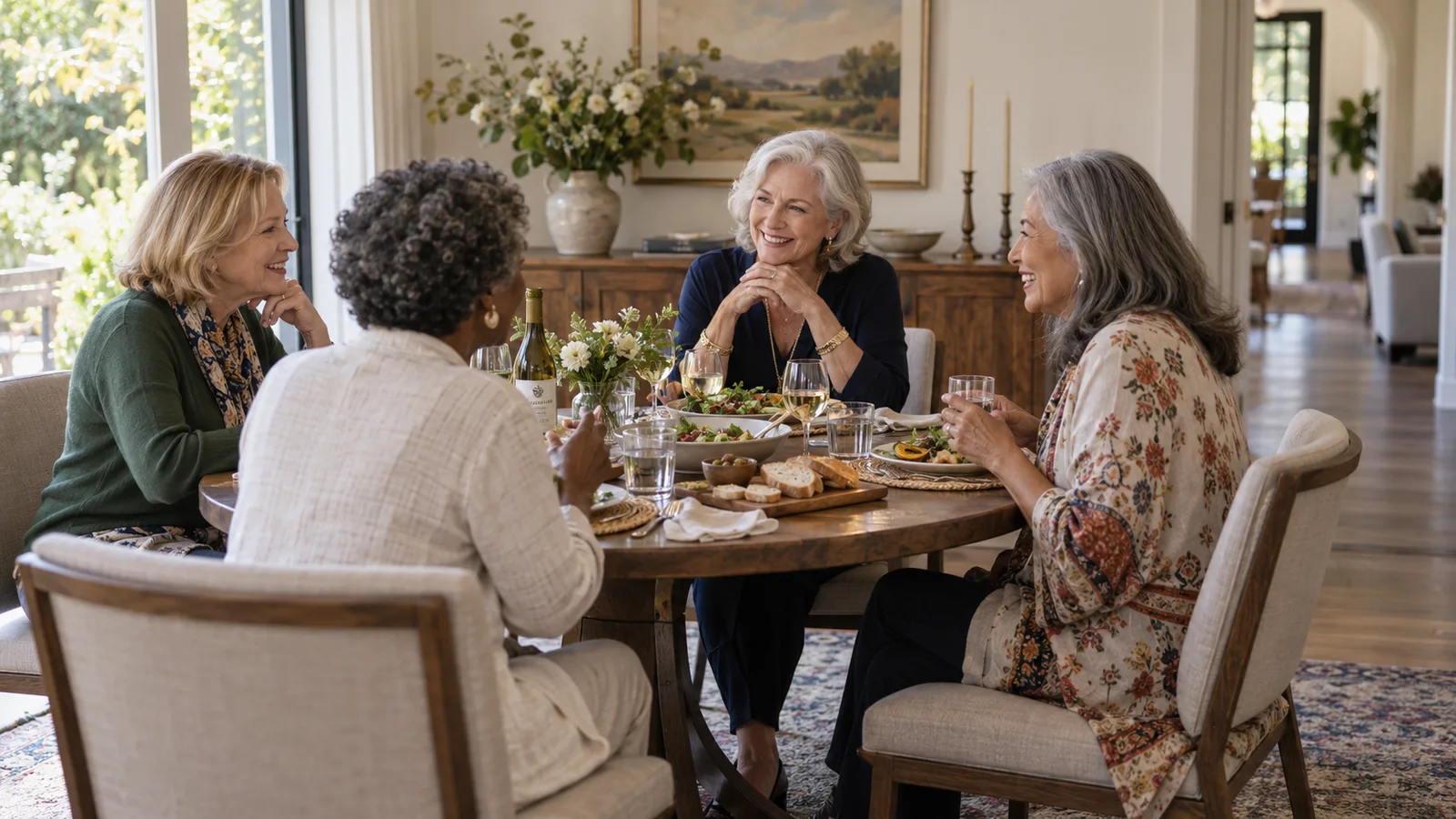
After the condolence visits end, the invitations that remain tend to be ones other people have arranged: a seat at someone else’s table, on someone else’s evening, among couples who knew you as half of a pair. Hosting reverses that arrangement. You choose the guests, the hour, the size of the table, and the moment the evening ends.
Begin with one date, four people and a stated end time. The practical decisions are smaller than “starting a social life again”: choose a format you can repeat, hire away the work that would keep you from the table, make the route through the house easy to navigate and serve alcohol with older guests’ medications and transport in mind.
Why the host holds the advantage
A guest arrives alone and must find her place in a room already arranged. A host is already there. The room, the seating, the menu, and the pace of the evening are hers, and so is the guest list, which is a quiet statement of whom you want in your life now.
You need not have been the hostess of the marriage. If your husband poured the drinks and told the stories, you are learning a new part, and a small table is the right place to learn it. Four to six guests allow one conversation rather than several. That matters more than it sounds: the National Institute on Aging observes that people with hearing loss can find conversation hard and may withdraw as a result. A quiet room with one shared conversation is kinder to every guest, including the host.
Regularity counts for more than scale. One well-judged lunch a month, held without fail, builds more than an occasional grand evening.
The first invitation can be direct without explaining your grief: “I am starting a small Sunday lunch at home, noon until two. I would love you to join me on the 18th; no need to bring anything.” A clear format, date and finish makes it easier for a guest to answer and for you to judge what you are actually committing to.
What the evidence on connection does, and does not, show
The most authoritative summary comes from the National Academies of Sciences, Engineering, and Medicine, whose 2020 consensus report found that nearly one quarter of Americans aged 65 and older living in community settings are socially isolated, and that 43 percent of adults aged 60 or older report feeling lonely. The committee concluded that more than four decades of research tie a lack of social connection, and social isolation in particular, to a significantly increased risk of early death from all causes; the report also associates isolation and loneliness with dementia and heart disease. The National Institute on Aging adds high blood pressure, weakened immune function, depression, and cognitive decline.
Read those findings precisely. They describe associations, not proof that a Sunday lunch will lower your blood pressure. The same report notes that poor health can itself make isolation more likely, so cause runs in both directions. It also distinguishes isolation, meaning few contacts, from loneliness, the feeling of being alone, and observes that the two often are not significantly correlated. You can live alone without being isolated, a point our guide to living alone for the first time develops, and you can feel lonely in a full room.
Hosting addresses the structure of a social life: regular contact, on a calendar. Whether it eases loneliness depends on the company you choose. The Academies committee also held that respecting individual choice about one’s own life is essential to any intervention. That is the argument for hosting on your own terms rather than on anyone else’s.
Four formats that suit a single host
The standing Sunday lunch
The same Sunday each month, the same hour, a table of four to six. Lunch ends naturally in the afternoon, so guests can usually drive home in daylight. Keep two or three regulars and one rotating seat for someone you would like to know better. Because the invitation stands, no one worries about returning it, and no one needs a reason to come. It is a different occasion from the holiday table, which carries family expectations of its own; our guide to holidays and family occasions treats those separately.
The small salon evening
Six to ten guests and one subject: a curator discussing an exhibition, an author reading, a musician playing for half an hour. The subject carries the conversation, which spares everyone small talk. Put the end time on the invitation, “six until half past eight”, and serve something more substantial than canapés.
The book or film circle
A monthly circle of six to eight, meeting at your house, with members taking turns to choose the book or film. The National Institute on Aging suggests restarting an old hobby or finding an activity you enjoy as a way to meet people with similar interests. A circle is a hobby with a guest list, and the discussion gives acquaintances something to say to one another from the first evening.
The garden afternoon
Larger, looser, and seasonal: the right format for mixing couples and single friends, neighbours and new acquaintances. Walk the route a guest will take, from the car to the terrace to the powder room, and look for uneven steps and poor light. In the heat, ask your caterer how cold food will be kept cold through the afternoon.
Help that removes the labour, and the tax line it can cross
A caterer, a server for the evening, someone to wash up: help is what lets a single host sit at her own table. Brief them in writing on the menu, the timing, and when to clear.
The federal tax rule turns on control. IRS Publication 926 says a worker is your household employee if you control not only what work is done but how it is done, and it lists cooks, butlers, and housekeepers among household workers. A caterer running an independent business that serves the public is generally self-employed, and staff whose work an agency controls are not your employees. A cook you hire and direct yourself may be. For 2026, if you pay one household employee $3,000 or more in cash wages, social security and Medicare taxes apply, and paying household employees $1,000 or more in any calendar quarter of 2025 or 2026 brings federal unemployment tax. State unemployment tax and workers’ compensation requirements vary; the publication directs you to your state’s unemployment tax agency and tells you to find out whether you must carry workers’ compensation insurance.
That is a rule. The recommendation is simpler: use established firms for occasional events, and if a cook becomes a regular part of the household, ask your accountant to set up household payroll properly. State law on a host’s liability for guests who drink also varies, so ask your insurance adviser how your homeowners and umbrella policies would respond.
Friendships that were built for four
Many friendships from a marriage were organised around the pair: dinners for four, the shared house in August, the standing Saturday table. Some couples will not know how to include one person, and some tables of couples will be painful to sit at. Your own table resolves much of this, because you set the terms.
Suppose a couple you and your husband dined with every month has gone quiet. Rather than wait to be asked, invite them to the Sunday lunch with two other guests. An odd number is not a failure of arithmetic, and seating need not follow marriages. If a friendship still does not recover its footing, our guide to when friendships change sets out how to decide what to ask for and when to let a connection settle into something smaller.
The host is the one person at the table who never has to wait to be asked.
Reciprocity without keeping score
Hospitality creates a gentle obligation. The risk for a host of means is scale. A table that is too grand can quietly close off the return invitation, because friends who cannot match it may stop trying.
Keep the food excellent and the setting unforced. When guests ask what to bring, give them something specific: the cheese, the flowers, a reading for the salon. Let a member of the book circle host once a season if she wishes. Accept invitations in return, even modest ones, and go. A standing invitation needs no repayment in kind, and saying so plainly relieves everyone.
Pouring for your guests, and for yourself
The National Institute on Alcohol Abuse and Alcoholism explains that older adults are more sensitive to alcohol’s sedative effects and its effects on balance and coordination, which raises the risk of falls and car crashes. With less muscle mass and body water, some older adults reach higher blood alcohol concentrations than younger people after the same amount, and research suggests women may be more susceptible to alcohol’s harms than men. The institute also notes that the death of a loved one can prompt some people to begin or increase drinking to cope with loneliness. The glass poured after the guests have gone deserves the same attention as the ones poured for them.
Medications matter most. NIAAA warns that combining alcohol with sleep, anxiety, or opioid pain medicines can be dangerous or deadly, and that aspirin with alcohol raises the risk of stomach bleeding. The Dietary Guidelines for Americans, 2025–2030, give no daily number: they advise consuming less alcohol for better overall health, and say that people taking medications or with conditions that interact with alcohol should avoid it completely.
Pour with measure. A U.S. standard drink contains about 14 grams of pure alcohol: 5 fluid ounces of table wine at about 12 percent, 3 to 4 ounces of sherry or port, or 1.5 ounces of brandy or spirits. NIAAA notes these amounts may not match customary serving sizes; a ten-ounce pour of the same wine counts as two. Serve food early, keep water on the table, and treat a good non-alcoholic option as seriously as the wine.
Before you send the first invitation
- Choose one format and a fixed recurrence, and put the next three dates in your calendar.
- Write a first guest list of four to six, including at least one person you would like to know better.
- State the start and end times on every invitation.
- Decide what help you will hire, and ask your accountant whether any worker you hire directly is a household employee under the 2026 rules in IRS Publication 926.
- Ask your insurance adviser how your homeowners and umbrella policies treat injuries to guests and alcohol served at home.
- Review your own medications with your physician or pharmacist before deciding what you will drink.
- Plan pours by standard drink, and choose a non-alcoholic option you would be pleased to serve.
- Walk the guest route for steps, lighting, and seating, and arrange the table for one conversation.
- After three gatherings, review who returned, what you enjoyed, and what to change.
This article provides general U.S. educational information and is not medical, legal, tax, or insurance advice. Confirm current rules with the agency and a qualified professional who knows your facts, and ask your own physician how alcohol interacts with your health and medications.
Primary sources
- National Academies of Sciences, Engineering, and Medicine: Social Isolation and Loneliness in Older Adults: Opportunities for the Health Care System, Report Highlights (2020)
- National Institute on Aging: Loneliness and Social Isolation: Tips for Staying Connected
- National Institute on Alcohol Abuse and Alcoholism: Aging and Alcohol
- National Institute on Alcohol Abuse and Alcoholism: What Is a Standard Drink?
- U.S. Department of Health and Human Services and U.S. Department of Agriculture: Dietary Guidelines for Americans, 2025–2030
- Internal Revenue Service: Publication 926 (2026), Household Employer's Tax Guide
This article provides general education, not individualized legal, tax, investment, insurance, or benefits advice. Rules and deadlines change; verify the current requirement with the agency and a qualified professional.
More from Living Well
The desk →
Living Well
Air Travel with Mobility Needs: A Door-to-Door Plan
Plan accessible air travel from curb to hotel, document a wheelchair or scooter, request the right assistance, and know whom to call when service fails.

Living Well
Choosing a Medical Alert System: A Home Test
Choose and test a medical alert system by matching coverage, monitoring, fall detection, response rules, power, privacy, contracts, and daily habits.

Living Well
Emergency Planning When You Live Alone: Support, Power, and Evacuation
Build an emergency plan for one-person households with a support network, medication and power contingencies, evacuation transport, records, and practiced check-ins.