Writing Family History: Memoir, Oral History, and Archives
Choose between memoir, letters and recorded interviews, use the Veterans History Project and National Archives records, and protect the living before you print.
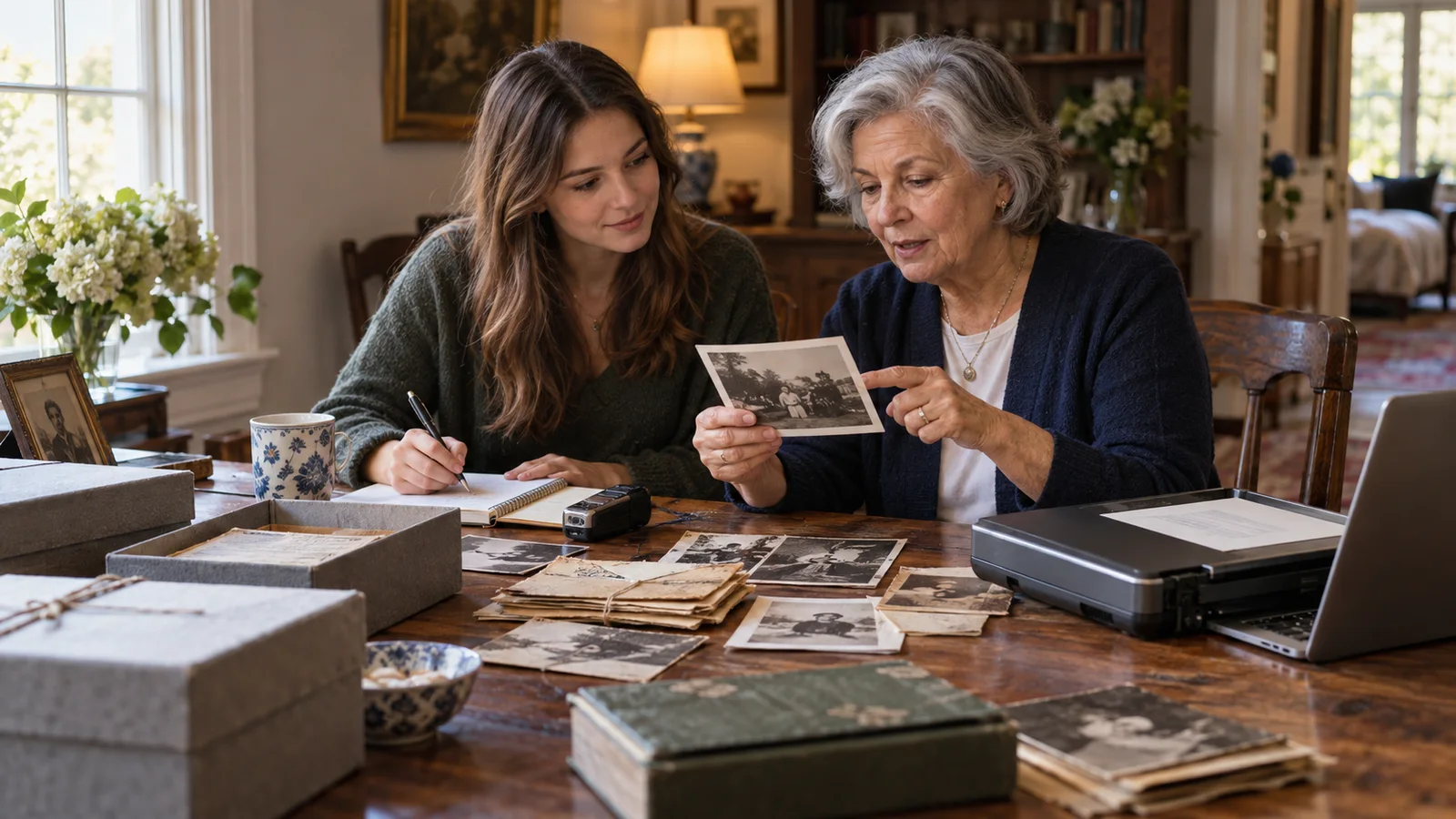
No appraiser will list it and no trustee is charged with keeping it, yet the most perishable thing in a family estate is its memory: who came from where, who served, why the house was bought, what the first business nearly cost. Much of that knowledge sat with your husband. What remains sits with you, with a few older relatives, and in boxes of papers that make sense only to someone who already knows the story.
Start with the person whose voice or identifications would be hardest to replace. Record first, label photographs second, and shape the book later. The method below comes from the Library of Congress’s American Folklife Center and the National Archives; it separates the complete family archive from the edited history you choose to circulate.
What a family history is for
It is not for settling anything. A will, a trust and a letter of wishes direct property and explain decisions; a family history explains people. Keep them apart, because a memoir that comments on who received what will be read as a verdict.
The better reasons are plainer. The people who can answer questions are finite. A photograph of four men on a pier is a treasure only while someone can name them. And grandchildren who never knew their grandfather will form a picture of him regardless; you can decide whether it is drawn from evidence.
An archive can tell your grandchildren what happened; only you can tell them what it meant.
Memoir, letters, or recorded voices
- A memoir is your account, in your voice, ordered as you choose: the most controlled form and the slowest to finish.
- Letters to grandchildren are shorter and addressed, easier to complete than a book, and can be sealed for delivery at a particular age.
- A recorded oral history keeps voices and reaches relatives who will talk but never write. It needs equipment, consent and cataloging to stay usable.
Most families combine them: recordings as the archive, a written narrative as the edition people read. The Folklife Center’s guide adds a point about scale: if video files are too large for the family to keep, audio may prove more durable.
Interviewing the way the Folklife Center teaches
The Center’s Folklife and Fieldwork (fourth edition, 2016) was written for community projects, but its method suits a sitting room.
- Obtain a release. Bring two copies and have both parties sign both. Anyone who later holds the recordings is bound by the release, not by promises made in conversation.
- Plan about an hour. Prepare twenty to twenty-five questions: short, open, one subject at a time, never leading. Let the pauses run.
- Mind the room. Avoid refrigerators and heating vents, which can be quiet when you arrive and noisy once recording starts. A lavalier microphone about six inches below the chin gives a clear voice; record the interviewer too.
- Announce the recording with the date, place, everyone’s names and the subject.
- Record at archival quality. The Center recommends WAV files at 96 kHz and 24 bits; compressed formats such as MP3 lose fidelity.
- Log it that week. A log is a time-coded list of topics. A full transcript takes, by the guide’s estimate, six to twelve hours per hour of interview.
Never record anyone without their knowledge. It is the guide’s ethical rule, and the simplest way to keep a family recording from becoming a family grievance.
If your husband served: the Veterans History Project
Congress created the Veterans History Project in 2000, within the American Folklife Center, to preserve the first-person accounts of U.S. veterans who served from World War I onward. Loved ones of a deceased veteran may submit his original letters, photographs, diaries or unpublished memoir. The minimums, the project’s 30-20-10 rule, are 30 minutes of unedited recorded interview, 20 pages of memoir or diary, or 10 photographs, letters, maps or pieces of two-dimensional art. Interviewers must be 15 or older, so a living veteran in the family makes a fitting project for a grandchild.
Read the release first. The Veteran’s Release Form, completed by the donor when the veteran has died, transfers the physical materials to the Library and grants it a perpetual, nonexclusive right to reproduce and distribute them; copyright stays with the veteran or his heirs. Collections without the required forms are returned. Because the project wants originals, digitize everything first. Its current submission guidance asks for shipment by commercial carrier, not the Postal Service, and requires a collection of more than 50 items to be arranged with project staff before it is sent. The project allows four to eight months from receipt for a collection to join the Library’s permanent collections, and possibly another four to eight before its contents appear online; it does not promise that items other than oral histories will go online at all.
His service file, from the National Personnel Records Center
The National Archives’ National Personnel Records Center releases the military personnel file, including the DD Form 214 separation document, to the veteran or next of kin: a surviving spouse who has not remarried, a parent, a child or a sibling. If you have remarried, one of your children can apply.
You will need his name as used in service, service number, Social Security number, branch, dates of service, and date and place of birth, with proof of death such as a death certificate or published obituary. Apply online through eVetRecs, which verifies identity through ID.me, or on Standard Form 180 by mail or fax.
Records become archival and open to the public 62 years after separation; subtract 62 from the current year, which in 2026 puts the line at 1964. Basic copies of more recent files are generally free to next of kin, and the Archives warns that companies charging for a DD 214 are selling a free service. Archival files carry a copying fee, listed in 2026 at $25 for five pages or fewer and $70 for six or more. If his file may have been caught in the Center’s 1973 fire, add his place of discharge, last unit and place of entry into service. Wait 90 days before following up.
The 1950 census and the rest of the National Archives
Census schedules are closed for 72 years. The 1950 census opened on April 1, 2022, and is free at 1950census.archives.gov with enumeration district maps. Its name index was built by machine-reading handwriting, and the Archives says it is not fully accurate. Search spelling variants and neighbors’ names; if a household still does not appear, find its enumeration district and read the pages in order. If you were born before April 1, 1950, you may find yourself in your parents’ household.
The Archives’ genealogy pages cover its other family records, including immigration and naturalization files. Its site search will not find a named individual, so start with those guides.
Writing about people who are still living
Federal practice is a useful guide to proportion. Census schedules wait 72 years; recent military files are only partly open to the public, under the Freedom of Information Act and the Privacy Act, until 62 years have passed. The same principle suits a family book: the closer an event is to the present, the more care it needs.
The Library of Congress’s release form asks contributors to release the Library from claims arising from its use of the collection, including claims for defamation, invasion of privacy and right of publicity. Those are the claims a published family story can attract, and state law governs them differently from state to state. A Veterans History Project donation also creates an online record with his name, service details and your name as contributor.
Show living relatives the passages about them before printing. Leave out health details, finances, addresses and confidences. Keep the complete archive separate from the edition you circulate, and say in your own estate papers when restricted material may be released. A book naming your houses or trustees also adds to what public records already reveal about a visible widow.
Keeping the recordings and printing the book
The Folklife Center’s recommendation for digital files is three copies on hard drives, one kept elsewhere, migrated to new drives about every five years. Keep the releases with the files, and note where the master set lives in your household and estate information index. For media scattered across phones and accounts, see what survives a phone contract. The guide also suggests offering the collection to an archive or library; you keep your copies.
Private publishing needs little legal machinery. Copyright exists automatically once a work is fixed in tangible form; a notice has not been required since March 1, 1989, and registration is optional. For a U.S. work, however, the Copyright Office must register or refuse the application before an infringement suit may be filed in federal court. Other people’s letters are the complication. Owning the paper letter does not by itself transfer copyright in the words. That copyright may pass by a signed transfer, will or state succession law, so confirm the chain of ownership rather than assuming that possession (or marriage)settled it. For most works created since 1978, copyright generally lasts for the author’s life plus 70 years; older and unpublished material can follow different rules.
A short family printing, with a page of sources and a note on what was left out, serves most purposes.
Questions to settle before you begin
- Who is the reader: grandchildren, the wider family, or a researcher a century from now?
- Which comes first: recordings, your memoir, or letters to grandchildren?
- Who should be interviewed this year, and by whom?
- Is there a signed release, in two copies, for every recording?
- Who qualifies as next of kin to request his service file?
- Which households should you look for in the 1950 census?
- Which passages concern living people, and who will read them first?
- Who holds the copyright in each letter you plan to quote?
- Where will the three copies of the archive live, and who will migrate them?
This article provides general U.S. educational information and is not legal, copyright, or privacy advice. Confirm current requirements with the Library of Congress, the National Archives, and a qualified attorney who knows your facts.
Primary sources
- Library of Congress, Veterans History Project: Field Kit
- Library of Congress, American Folklife Center: Folklife and Fieldwork: An Introduction to Cultural Documentation (4th ed., 2016)
- National Archives: Request Military Service Records
- National Archives: 1950 Census Records
- National Archives: Resources for Genealogists and Family Historians
- U.S. Copyright Office: Circular 1, Copyright Basics
- U.S. Copyright Office: What Writers Should Know about Copyright
This article provides general education, not individualized legal, tax, investment, insurance, or benefits advice. Rules and deadlines change; verify the current requirement with the agency and a qualified professional.
More from Living Well
The desk →
Living Well
Air Travel with Mobility Needs: A Door-to-Door Plan
Plan accessible air travel from curb to hotel, document a wheelchair or scooter, request the right assistance, and know whom to call when service fails.
Living Well
Choosing a Medical Alert System: A Home Test
Choose and test a medical alert system by matching coverage, monitoring, fall detection, response rules, power, privacy, contracts, and daily habits.
Living Well
Emergency Planning When You Live Alone: Support, Power, and Evacuation
Build an emergency plan for one-person households with a support network, medication and power contingencies, evacuation transport, records, and practiced check-ins.